
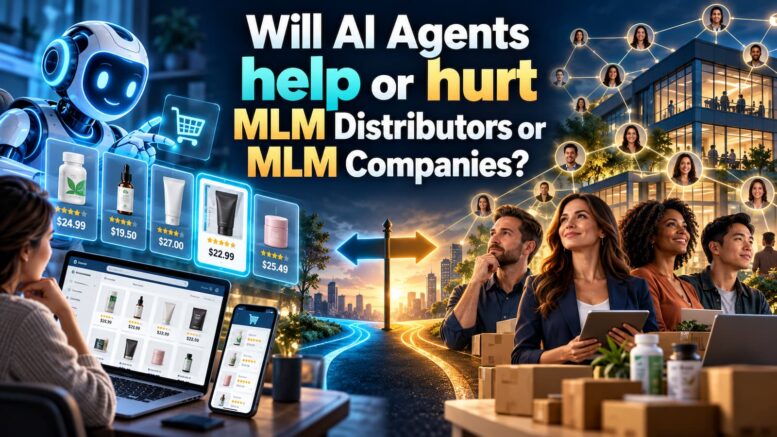
Will AI Agents help, hurt or both in MLM
Artificial intelligence is changing how consumers research products, compare prices, and decide where to spend their money. For multilevel marketing companies and independent distributors, this development reaches well beyond another social media trend. It could change how customers evaluate product value, maintain purchasing relationships, and assess business opportunities.
Learn more on Building Fortunes Radio https://buildingfortunesradio.com and Youmongus Radio Network https://youmongusradio.com
For years, a distributor’s advantage often included introducing a product, explaining its benefits, and making the buying process personal. Those advantages still matter. However, customers increasingly have access to digital assistants that can research alternatives before, during, or after a sales conversation.
A customer can ask an AI shopping assistant a practical question: “Can I find something comparable for less, including shipping, without a monthly commitment?”
That question puts price, evidence, convenience, and service at the center of the buying decision.
The following analysis examines the likely business implications of these tools. The direction is becoming clearer, but the pace of adoption and the results for individual MLM companies remain uncertain.
What Makes AI Shopping Agents Different?
A traditional search engine gives consumers links. An AI shopping assistant can organize information around a shopper’s needs, explain differences, and recommend options. An agent can go further by taking actions, such as monitoring prices, assembling a cart, or completing an authorized purchase where supported.
These capabilities vary by platform. Some tools operate mainly within one retailer’s inventory. Others can discover products across participating merchants or interact with outside websites.
Consumers will not automatically receive a complete, unbiased comparison of every available product. Access restrictions, incomplete information, platform incentives, and errors can affect recommendations.
Nevertheless, reducing the effort required to compare products is significant. A shopper who previously accepted the first convincing presentation may now request a second opinion in seconds.
For MLM distributors, the emerging competitive challenge is a customer who arrives with more questions, more alternatives, and less willingness to accept unsupported claims.
Amazon, Walmart, eBay, Shopify, and Meta Are Building This Shopping Environment
Amazon’s Alexa for Shopping builds on its earlier Rufus assistant. Amazon describes capabilities including product comparisons, price history, personalized recommendations, and assistance with routine purchasing. These features can make research and repeat buying more convenient.
Walmart’s Sparky provides conversational shopping assistance, product recommendations, and answers based on customer preferences. Walmart describes Sparky as a tool designed to help customers shop within its retail environment.
eBay has announced an AI shopping agent intended to create a more personalized experience using its marketplace inventory and product information. For shoppers considering alternatives, marketplaces can introduce different sellers, conditions, and purchasing options.
Shopify plays a different role. It provides commerce infrastructure for merchants rather than operating solely as a single retailer. Its Agentic Storefronts and Shopify Catalog help participating products become discoverable through AI channels, including Microsoft Copilot and other supported services.
Meta has introduced Muse, a personal AI agent accessible through its own app and WhatsApp. This brings task-oriented assistance into a messaging environment where people already communicate.
Together, these developments suggest that shopping will increasingly begin with a conversation about a need. The consumer may describe a problem before choosing a brand, seller, or website.
Price Transparency Will Put More Pressure on MLM Products
One likely impact is increased scrutiny of product prices.
MLM companies compete in categories such as personal care, nutritional products, household goods, and beauty. Customers can already compare these products manually. AI makes that comparison easier to organize.
A shopper may ask about package size, cost per serving, shipping charges, subscription requirements, and return policies in one conversation.
Consider a hypothetical product priced at $60 for 30 servings, with $8 shipping. Its delivered cost is approximately $2.27 per serving. An alternative priced at $38 for 30 servings, with free shipping, costs approximately $1.27 per serving.
Those calculations do not establish that the products are equivalent. Formulation, testing, quality, and service may differ. However, they create a clear question: What supports the additional cost?
A premium brand can answer that question with documented advantages. A distributor who relies only on enthusiasm may struggle.
The pressure will be greatest where customers can find credible alternatives and where the company has difficulty explaining its premium in terms that matter to buyers.
“Similar Ingredients” Will Not Automatically Mean “The Same Product”
AI comparisons can help shoppers, but they can also oversimplify.
Two products may share an ingredient while differing in concentration, formulation, stability, manufacturing standards, or independent testing. A similar label does not establish identical performance.
This creates an opportunity for knowledgeable distributors.
The strongest response to a comparison is a careful explanation of the differences that can actually be verified. Customers need specific facts rather than blanket statements that every alternative is inferior.
For example, a distributor might explain differences in ingredient quantities, documented testing, packaging, or authorized seller support. Where the evidence is limited, that limitation should be acknowledged.
For wellness products, AI-generated comparisons should not be treated as personalized medical advice. Product education also needs to distinguish between research on an ingredient and evidence about the finished product.
Accurate explanations can strengthen trust, particularly when the distributor is willing to recognize that another option may suit a particular customer better.
Social Media Discovery May Lead to a Purchase Somewhere Else
Social media has become a major introduction point for direct selling products.
A distributor posts a demonstration, shares a personal experience, or discusses a product during a live broadcast. A viewer becomes interested and follows up.
AI adds another possible step between interest and purchase.
The viewer may ask an assistant to research the product, locate competing options, or compare the offer with items available elsewhere. The distributor’s content creates demand, but another seller may receive the order.
This is a plausible commercial consequence of easier comparison, rather than a prediction that every platform will handle shopping identically.
Distributors should therefore examine what happens after someone discovers their content. Does the customer find a clear product page? Are prices and policies easy to understand? Is the distributor’s service visible?
Attention remains valuable. Converting that attention will require a convincing explanation of why purchasing through that distributor serves the customer.
Personal Relationships Will Still Matter, but Their Role Will Change
People often buy from distributors they know and trust. AI shopping agents will not eliminate friendship, community, or the value of reliable service.
However, a relationship may become less effective at overcoming a persistent value gap.
Someone may gladly support a friend with an occasional purchase while using an assistant to review recurring expenses. When several monthly subscriptions compete for a household budget, sentiment may have limits.
The distributor’s role can evolve toward helping customers make appropriate choices.
That includes explaining usage, answering questions, resolving problems, and respecting a customer’s decision to decline or cancel. It also includes recognizing when a product is a poor fit.
A relationship becomes more durable when customers feel understood and well served. Pressure to purchase mainly to support someone else’s business can weaken that relationship.
Recurring Orders and Autoship Will Face Closer Review
Recurring purchasing supports predictable revenue for many businesses, including MLM companies.
As AI tools become more capable of helping people organize spending, customers may use them to review whether subscriptions remain useful.
A shopper could ask: “What am I buying every month, what am I actually using, and what alternatives should I consider?”
The effect will depend on the assistant’s access and capabilities. It should not be assumed that every shopping tool can inspect accounts or cancel subscriptions.
The broader implication is straightforward. Customers may become more deliberate about repeat orders.
Companies can respond with flexible delivery schedules, clear renewal information, easy cancellation, and reminders that reflect actual usage. Distributors can help customers avoid accumulating products they do not need.
Retention based on continued satisfaction is more resilient than retention dependent on overlooked renewals.
Distributor Economics Could Become More Difficult
If comparison shopping reduces conversion rates or average order values, distributors may need more effort to generate the same revenue.
Companies might respond with promotions, revised pricing, bundles, or different compensation arrangements. Any reduction in compensation per sale could affect distributor profitability.
These outcomes are possibilities, not inevitable consequences. A company with strong customer demand and clear differentiation may experience a different result.
Distributors should nevertheless understand their numbers.
Revenue alone does not show whether a business is profitable. Product costs, shipping, samples, advertising, software, events, and other expenses can affect the result.
AI may improve efficiency, but it cannot automatically create demand or make an unprofitable offer profitable. Producing more messages and posts is useful only if the activity contributes to sustainable customer purchases.
Recruiting Presentations Will Receive More Independent Scrutiny
The impact extends beyond retail products.
Prospective distributors can use AI tools to organize questions about income disclosures, compensation plans, startup costs, and ongoing expenses. They may also compare MLM participation with affiliate marketing, conventional sales work, or other business options.
A recruitment presentation may become the beginning of research rather than the final word.
The FTC’s review of 70 MLM income disclosures identified concerns including omitted low or zero earners, expenses that were not accounted for, and emphasis on earnings received by relatively few participants. Those findings concerned the reviewed disclosures and should not be treated as identical results for every company.
For recruiters, the practical lesson is to provide clear, realistic information.
An AI assistant can also misunderstand a compensation plan. Prospects should verify summaries against current company documents. Even so, easier access to organized questions makes selective presentations less persuasive.
AI Will Help Distributors as Well as Their Customers
Distributors can use AI to prepare educational material, organize follow-up schedules, summarize approved product information, and identify common customer questions.
These tools can reduce administrative work and help a distributor communicate more clearly.
A useful approach begins with an actual customer need. For example, repeated questions about package sizes could become a straightforward buying guide. Questions about subscriptions could become a clear explanation of ordering choices.
Human review remains essential.
An assistant may invent a benefit, misstate a policy, or produce an exaggerated income claim. Distributors remain responsible for the material they publish.
Customer information also deserves careful handling. Contact details, private conversations, and sensitive information should only be used with appropriate permission and safeguards.
AI is most valuable when it improves accuracy and service, rather than simply multiplying promotional activity.
More Automated Outreach Could Make Trust Harder to Earn
When promotional content becomes inexpensive to produce, social media feeds and inboxes can become more crowded.
Consumers may encounter repetitive messages, generic testimonials, and sales approaches that appear personal but were generated automatically.
That can increase skepticism.
If customers learn to expect automated persuasion, they may turn to their own assistants to evaluate offers. The sales process could increasingly involve a seller’s automated tools competing with a buyer’s automated research.
Distributors can respond by communicating with specificity.
Real demonstrations, direct answers, thoughtful interviews, and honest explanations provide more substance than generic enthusiasm. Permission-based follow-up also gives customers greater control.
Being recognizable, accountable, and useful may become a stronger advantage as automated content becomes more common.
MLM Companies Need Product Information That AI Can Understand
Companies should assess whether their public product information supports accurate comparison.
Useful information includes complete descriptions, package quantities, ingredients where relevant, current prices, availability, shipping terms, subscription conditions, and return policies.
Shopify’s guidance emphasizes complete, structured product information and established SEO practices for discovery through its agentic commerce tools. That illustrates the importance of accessible product data.
For MLM companies, clear information serves both human shoppers and automated systems.
Claims supported only by an image, a private presentation, or vague promotional language are harder to evaluate. Public pages should explain what the product does, what evidence supports it, and what the purchase requires.
This does not guarantee an AI recommendation. It improves the information available when a customer or assistant investigates the offer.
Referral Attribution Will Become an Important Business Issue
MLM companies also need to consider how agent-assisted purchasing interacts with distributor credit.
A distributor may introduce a product, but the customer may later complete the purchase through a different route. Whether the distributor receives credit depends on the company’s systems and the relevant checkout integration.
Companies should test these situations rather than assume existing referral links will always behave as expected.
They need to understand whether customers retain their distributor association, whether referral details survive the purchasing process, and how disputes are resolved.
Distributors need clear explanations of those rules.
Customer convenience and distributor compensation must work together. Otherwise, a smoother shopping experience could create confusion about who receives credit for the sale.
A Premium Price Needs a Customer-Focused Explanation
AI comparison shopping does not mean the lowest-priced product always wins.
Customers may value quality, convenience, formulation, service, or an established relationship. A higher-priced product can compete successfully when its advantages are meaningful and credible.
However, the cost of maintaining a compensation structure is not, by itself, a customer benefit.
The buyer wants to know what the additional spending provides.
Companies should examine whether their products attract repeat purchases from people who have no interest in recruiting or qualifying for compensation. That is an important commercial test of customer demand.
Distributors can strengthen their position by explaining value in terms the customer can assess, rather than expecting the customer to share the company’s enthusiasm for its business model.
Practical Steps for MLM Distributors
Distributors can begin adapting with a few focused actions:
- Compare their products with realistic alternatives using total delivered cost.
- Learn the documented differences without overstating them.
- Publish clear answers to common product and ordering questions.
- Review recurring orders with customers based on actual usage.
- Track business expenses and customer retention.
- Use AI for useful preparation while checking every factual claim.
- Build service around customers’ needs and preferences.
Companies can support this work with accurate product data, practical training, flexible purchasing options, and reliable referral systems.
Neither group needs to predict every technology change. Both need to understand how easier research affects the customer’s decision.
The Future of MLM Will Depend on Demonstrable Value
AI shopping agents are likely to make comparison faster, purchasing more convenient, and unsupported sales claims easier to question.
That creates pressure for MLM companies and distributors whose offers depend heavily on limited comparison, emotional urgency, or confusing information.
It also creates opportunities for businesses that provide distinctive products, clear evidence, transparent pricing, and dependable service.
The key question is whether a customer, after examining credible alternatives, still chooses the product and wants to purchase through the distributor.
Companies and distributors that can earn that choice will have a stronger foundation as AI becomes a larger part of everyday shopping. Keep informed with Peter Mingils on MLM News and Building Fortunes Radio